
Pilonidal cyst, a.k.a. pilonidal sinus, is a painful condition caused by rapid infection and swelling in the sacral area, i.e. the upper crease of the buttocks.
Enjoy the article. Feel free to contact me if you have any further questions, or drop into my Rockhampton studio for a chat. My details are on the bookings page.
Have a brilliant day,
Andrew (Thommo) Thompson


Cause
Pilonidal cysts are commonly associated with ingrown hairs, which in turn, are caused by the inability of hairs to break through the skin due to obstruction or chaffing.
'Pilonidal' literally means 'nest of hairs'. A sinus is a tunnel-like structure in the skin, and a cyst occurs when that tunnel becomes blocked.
Contributing factors include the anatomy of the buttock cleft itself, excessive body hair, and a genetic predisposition to coarse hair.
While pilonidal cysts can occur in anyone, the overwhelming majority of people afflicted are teenage boys going through puberty and men aged 18 to 35 with dense body hair.
This period of life is when most new hairs are sprouting, and dense hair translates to more chances for infection.
Prevalence
I work on intimate body parts every day, and I come across pilonidal cysts a lot, or at least, their post-operative scars.
These cysts form so quickly and are so very painful, that they require fast surgery. For that reason, it's very rare to see one in the wild.
That said, I have identified a few over the years while they were forming, and was able to rush the clients off to their GPs.
The first symptom is usually localised redness that can be easily mistaken for a pimple or boil, however it continues to grow rapidly, as does the pain.
Treatments
If the cyst is in its early stages, your GP may attempt to lance it in their treatment rooms. Sometimes, they might err on the side of caution and admit you to hospital.
Surgery involves draining the pus from the cyst and then following the sinus to the primary site of infection. The debris that caused the blockage will be removed and the sinus excised so it cannot recur.
Unfortunately, rates of recurrence are quite high, most notably in people who have a genetic predisposition, or simply, dense body hair.
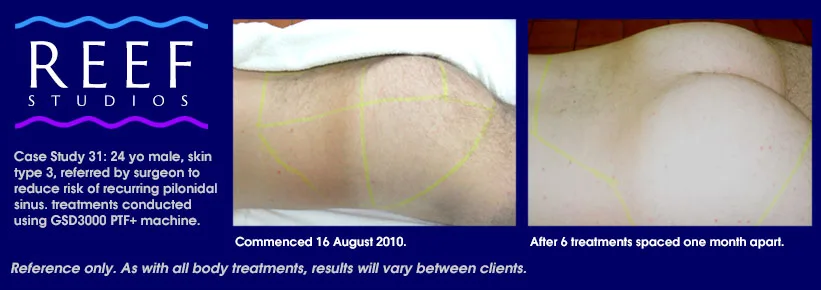
The first step in reducing the chance of recurrence is to ensure hygiene in the area. The second step is to permanently remove all hair along the centre line over the sacrum.
While some types of hair removal, such as men's waxing, plucking, shaving, or creams, will temporarily remove the hair, they aren't a solution.
In fact, these temporary methods might actually cause an ingrown hair, which could lead to the formation of another pilonidal cyst.
For this reason, a permanent type of hair removal such as IPL is a commonly recommended solution.